MEP Design
Mechanical, electrical, and plumbing systems that conflict with structure or each other cause delays, rework, and operational failure. We design and coordinate MEP against structure and architecture so spatial and performance issues are resolved before construction.
Why MEP Design Matters
MEP systems occupy the most contested space in a building. Ducts, pipes, cable trays, and equipment compete for the same ceiling voids, risers, and service corridors. Without coordination, conflicts are discovered during installation.
- Ductwork routed through structural members because headroom was not checked against the structural drawings
- Electrical and plumbing risers clash because vertical coordination was done on 2D drawings
- Equipment selected without verifying access for maintenance, forcing redesign after installation
- Fire and smoke control systems designed in isolation, creating conflicts with HVAC routing at site
What We Deliver
Mechanical Systems
- HVAC sized for load, comfort, and energy performance
- Duct routing coordinated against structure and other services
- Ventilation, smoke control, and fire systems designed as one integrated package
- Equipment selected with maintenance access verified in the model
Electrical Systems
- Power distribution and panel schedules designed to actual load requirements
- Lighting layouts coordinated with ceiling and architectural intent
- Emergency, earthing, and lightning protection to code
- Low-voltage systems (CCTV, access control, data) routed and coordinated with other services
Plumbing and Drainage
- Water distribution and drainage sized and routed with cross-discipline coordination
- Riser coordination checked against structural openings and architectural layout
- Rainwater and water reuse systems integrated where specified
- Civil interface points confirmed before construction
Cross-Discipline Coordination
- All MEP systems modeled in Revit and clash-checked against structure and architecture
- Spatial conflicts resolved during design, not discovered at installation
- Load summaries, equipment schedules, and documentation produced for coordination
- Maintainability and access reviewed before drawings are issued
How MEP Coordination Is Controlled
MEP coordination fails when it is treated as a late-stage check instead of a continuous process. We run coordination against the structural and architectural drawings on a fixed cycle so conflicts surface during design, not during installation.
- Model coordination run against structure and architecture at every design stage.
- Clash detection reviewed weekly with resolution owners assigned per issue.
- Service routing checked for headroom, access, and maintenance clearance before drawings are issued.
- Design changes impact-assessed across all MEP disciplines before approval.
- Standards compliance (ASHRAE, IEC, IPC) verified per discipline with local adaptation where required.
Canopy Framework
Coordination as the System
MEP touches every discipline and every space in the building. Coordination is not a review step at the end. It is built into how routing decisions, equipment selections, and spatial allocations are made from the start.
“Shape the terrain so the right path is the easy path.”
Learn more about our approachHow Teams Coordinate
MEP design requires constant alignment with architecture and structure. Coordination runs on a fixed cycle so routing conflicts and spatial issues are resolved before they reach issued drawings.
- MEP model federated with structure and architecture; clashes flagged per cycle
- Coordination reviews scheduled weekly with resolution owners assigned
- Service routing changes impact-assessed before model update
- Reports issued with marked-up sections and tracked action items
Selected Case Study
MEP coordination on a laboratory facility with critical environmental and continuity requirements.
Case Study
Resilient Infrastructure & Smart Research Backbone
Owner-side MEP design for a national research facility requiring resilience against flood, contamination, and utility failure.

Civil, sanitary, HVAC, and digital infrastructure were designed independently with no unified resilience approach. Flood protection, contamination control, water continuity, and HPC uptime were treated separately. An integrated design approach was imposed, aligning redundancy, containment, and failover across building systems.
Executive Summary
A national research facility required infrastructure capable of operating under flood risk, contamination control requirements, and utility failure. The project lacked a coordinated approach across civil, sanitary, HVAC, and digital systems, creating risk of single points of failure. An integrated infrastructure design was introduced, aligning flood protection, water systems, HVAC containment, and backup power. Redundancy and failover were coordinated across systems, supporting continuous operation under failure scenarios.
Project Snapshot
- Client
- Department of Agricultural Affairs (DOA)
- Location
- Chatuchak (Bang Khen), Bangkok, Thailand
- Site Area
- Approx. 25,000 sqm GFA
- Contract Value
- USD 3 million
- Duration
- 36 months (design & construction)
- Services Delivered
- Civil Engineering, Sanitary & Chemical, Laboratory HVAC & Special Ventilation, Waste Management, Hydraulic Modeling, HPC Infrastructure (Cooling & Power), Digital Commissioning
The Challenge
The context, constraints, and risks shaping the project from the start.
The project required infrastructure capable of maintaining operation under flood risk, contamination control, and utility failure. Failure would affect research samples, equipment, and data.
Complexity
- Flood risk requiring protection against operational loss
- Contamination and discharge requirements for laboratory systems
- HPC systems requiring redundancy beyond conventional design
What Was at Stake
Without resilient infrastructure, flood events or utility failures could disrupt operations, compromise compliance, and damage research.
How Chenla Stepped In
The targeted actions we took to resolve the core issues.
An integrated infrastructure design was imposed across civil, sanitary, HVAC, and digital systems, enforcing redundancy and verifying failure response through testing.
Key Actions
- Raised platform level defined from hydraulic modeling and drainage limits
- Water continuity provided through storage and redundant supply lines
- Gravity-based water distribution used to maintain pressure during outages
- Chemical waste routed through a dual-drain network to a treatment plant
- Laboratory HVAC designed with 100% outdoor air and pressure control
- HPC systems supported by redundant power and cooling paths
- Failure response verified through testing and simulated outage scenarios
Framework in Action
The Canopy Framework™ principles most active on this project.
The engineering principles later formalized into internal methods can be seen here. Civil, sanitary, HVAC, and digital systems were coordinated to remove single points of failure. Hydraulic modeling, redundancy design, and testing verified system performance under failure conditions.
Coordination as the System
“Shape the terrain so the right path is the easy path.”
Upstream Intervention
“Catch it on paper, not on site.”
Solution Highlights
What Chenla delivered to address the project's challenges.
Flood Defense by Design
An elevated platform protects critical systems above flood levels.
Water Security
Water storage and gravity-driven distribution maintain supply during outages.
Laboratory HVAC Containment
100% outdoor air systems and controlled exhaust maintain containment.
HPC Uptime
Redundant power and cooling were validated through testing.
Outcomes
What changed for the client as a direct result of our intervention.
Operational Results
- Continuous operation supported through redundancy and failover
- Reduced flood risk exposure
- Reduced energy use
- Chemical waste treatment capacity established
Client Benefits
- Continuity of research operations during floods and outages
- Reduced environmental and regulatory risk
- Lower lifecycle costs
- Resilient infrastructure for research computing
PROJECT DOCUMENTATION & OUTPUTS
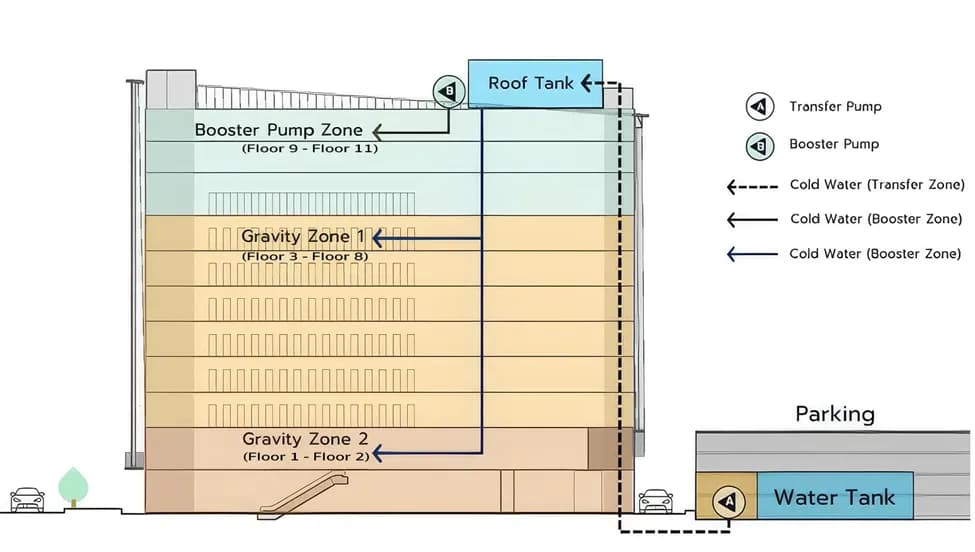
Down-Feed Water System Diagram
Diagram showing roof tanks, gravity mains, and water distribution.
Start with an MEP coordination review
Share your drawings or design stage. We will identify where MEP coordination needs strengthening and how our team can support. We respond within one working day.