Project Management
When no one owns alignment across owner, consultants, and contractors, decisions stall, scope drifts, and cost compounds. We track decisions, enforce deadlines, and hold alignment across all parties from first briefing through handover.
Why Project Management Matters
Projects do not fail from one bad decision. They fail from accumulated misalignment: decisions deferred, responsibility unassigned, and stakeholders operating from mismatched scope, conflicting budget figures, and divergent programme dates.
- Decisions deferred during design surface as forced choices on site, at higher cost
- Owner, consultants, and contractors each assume different scope until a conflict exposes the gap
- Cost and programme drift because no one tracks commitments against the approved baseline
- Issues visible to multiple parties but owned by none, accumulating until they block execution
What We Control
Decision Structure and Authority
- Every decision tracked with owner, deadline, and dependencies
- Trade-offs presented with cost, schedule, and scope impact before the owner decides
- Escalation paths defined so unresolved items do not stall progress
- Authority and accountability assigned per issue, not left to assumption
Stakeholder Alignment
- Owner, consultant, and contractor alignment enforced through fixed coordination cycles
- Information flow governed so each party works from the same scope and programme
- Consultant selection, briefing, and performance managed on behalf of the owner
- Trilingual delivery (Khmer, Thai, English) so nothing is lost between teams
Programme and Cost Control
- Schedule built and tracked against committed milestones, not aspirational dates
- Budget monitored against approved scope with variation impact assessed before approval
- Procurement managed with transparent evaluation and recommendation
- Financial reporting issued on a fixed cycle with clear cost-to-complete status
Execution and Handover
- Progress measured against plan; slippage flagged before it compounds
- Contractor coordination managed through structured reporting and issue tracking
- Testing, commissioning, and punch-list closure tracked to completion
- Handover documentation and as-built coordination started during construction, not at the end
How Decisions Are Executed
When decisions lack structure, projects stall. Open items are tracked, trade-offs documented, resolutions assigned. Unowned issues do not accumulate -- they are caught and escalated.
- Decision log maintained with owners, deadlines, dependencies, and resolution status.
- Information flow structured so decisions are made with verified data, not assumptions.
- Trade-off evaluation documented with cost, schedule, and quality impact before approval.
- Escalation protocol triggers when items remain unresolved past their deadline.
- Weekly reporting with status, risks, and required actions clearly stated.
Canopy Framework
Coordination as the System
Alignment is not achieved through intent or more meetings. It is built through clear ownership, short feedback loops, and a decision structure where the right path is the obvious path. This is how every project is run.
“Shape the terrain so the right path is the easy path.”
Learn more about our approachHow Teams Coordinate
Owner, consultants, and contractors each have different priorities and different information. Coordination runs on a fixed structure so alignment is enforced at every stage.
- Weekly coordination meetings with structured agenda and tracked actions
- Issue log maintained with assigned owners and resolution deadlines
- Progress and cost reports issued on a fixed cycle
- Escalation triggered when items are unresolved past their deadline
Project Lifecycle
The same controls run across every phase. What changes is the focus. The discipline stays constant.
Preconstruction
Feasibility, risk mapping, schedule and budget development, consultant selection, permitting path.
Design and Procurement
Design coordination, value engineering, procurement strategy, bid evaluation, contract finalization.
Construction
Progress tracking, issue resolution, scope and change control, contractor coordination, stakeholder reporting.
Handover
Testing and commissioning, punch-list closure, as-built documentation, final accounts.
Selected Case Study
Project coordination on a mixed-use entertainment venue under real programme and stakeholder constraints.
Case Study
SHOW DC – Owner's Representative & Project Management
Owner-side project coordination for a 156,000 sqm retail and entertainment development across 20+ construction packages, 8 design firms, and multiple authorities.
Coordination, reporting, and decision flow were centralized across 20+ packages, 8 design firms, multiple internal departments, and external authorities. Package-level fragmentation was brought under structured interfaces, consolidated cost visibility, and decision-ready executive reporting.
Executive Summary
A mixed-use development with 20+ parallel packages and 8 design firms had no centralized coordination function. Structured workflows and reporting were imposed across design, construction, tenant requirements, and authorities. Decision-ready reporting was formalized for the CEO and Executive Board. Over three years, this structure held progress, alignment, and decision flow across all stakeholders.
Project Snapshot
- Client
- Show DC Corp., Ltd.
- Location
- Bangkok
- Site Area
- 156,000 sqm
- Contract Value
- Approx. USD 110 million
- Duration
- 3-year programme
- Services Delivered
- Project Management, Owner's Representation, Design Coordination, Construction Oversight, Tenant Coordination & Fit-Out, Budgeting & Cost Control, Authority Coordination, Executive Reporting
The Challenge
The context, constraints, and risks shaping the project from the start.
The project involved major retail anchors, live entertainment attractions, and overlapping dependencies between internal departments, consultants, contractors, and authorities. Constant design changes, simultaneous tenant fit-outs, and multiple external coordination points required someone to impose structure on a fast-moving and interdependent programme.
Complexity
- 20+ construction packages delivered in parallel across a large mixed-use site.
- 8 design firms producing 10+ major design packages requiring daily interface management.
- Anchor attractions demanding specialized technical, theatrical, and operational coordination.
- Multiple internal departments—Operations, IT, Finance, Marketing, Tenant Relations—requiring aligned decision flows.
- External authorities affecting access, traffic flow, utilities, and opening readiness.
What Was at Stake
Without a structured project development function, the Owner risked cost overruns, delayed opening, misaligned tenant handovers, and reputational exposure linked to high-profile anchor attractions. Unmanaged design changes also threatened to impact revenue areas and the readiness of critical public-facing spaces.
How Chenla Stepped In
The targeted actions we took to resolve the core issues.
A project development function was embedded within the client's organization, centralizing design coordination, construction oversight, tenant coordination, authority management, and executive reporting under a defined structure.
Key Actions
- Design coordination structured across 8 firms through defined interfaces, controlled submission flows, and daily alignment routines.
- Tenant submission and approval protocols formalized. Handbooks standardized compliance with mall design requirements.
- Independent CM and QS oversight imposed to verify progress reporting, cost updates, procurement status, and risk exposure.
- Budgets consolidated across all packages with early-warning mechanisms for design-driven cost impacts.
- Authority coordination centralized: statutory approvals, public access, utilities, and traffic flow governed through a single interface.
- Executive reporting formalized on a fixed cycle: design changes, progress, cost exposure, and risk analysis structured for Board-level decision-making.
Framework in Action
The Canopy Framework™ principles most active on this project.
The same principles later formalized into a unified system can be seen here across 20+ packages, 8 design firms, and multiple internal departments. Coordination was not overhead -- it was the operating structure. Structured weekly reporting gave the Executive Board visibility across time, cost, and design impacts before decisions were required.
Coordination as the System
“Shape the terrain so the right path is the easy path.”
Continuous Visibility
“Silence is not neutral.”
Solution Highlights
What Chenla delivered to address the project's challenges.
Building a Project Development Function
Design, construction, tenant, and authority coordination centralized under one leadership structure embedded within the client's organization.
Structured Decision-Making for Executives
Weekly reporting translated site activity into decision-ready insights for the CEO and Board, reducing response time to emerging risks.
Coordinating Complex Interfaces
Requirements of retail anchors, entertainment partners, internal departments, and authorities aligned so downstream impacts were understood before decisions were issued.
Delivering Opening Readiness
Continuous progress monitoring and forecasting structured to prepare the development for commercial opening.
Outcomes
What changed for the client as a direct result of our intervention.
Operational Results
- 20+ construction packages and 8 design firms coordinated through structured daily interfaces.
- 100% MEP system completion prior to commissioning handover: electrical, fire protection, HVAC, lifts, escalators, CCTV.
- 280+ tenant units inspected for defects and as-built compliance. 14% active defect list resolved prior to opening.
- Budgets consolidated across all packages with ongoing forecasting tied to design changes.
- Authority coordination delivered for access, utilities, traffic approvals, and operational permits.
Client Benefits
- Consolidated visibility across time, cost, and design impacts.
- Faster executive decisions through structured reporting and early warnings.
- Stronger control over tenant onboarding, fit-out compliance, and handover sequencing.
- Reduced coordination risk across consultants, contractors, tenants, and internal departments.
PROJECT DOCUMENTATION & OUTPUTS
Case Study Overview
Summary graphic of the Show DC project scope and development structure.
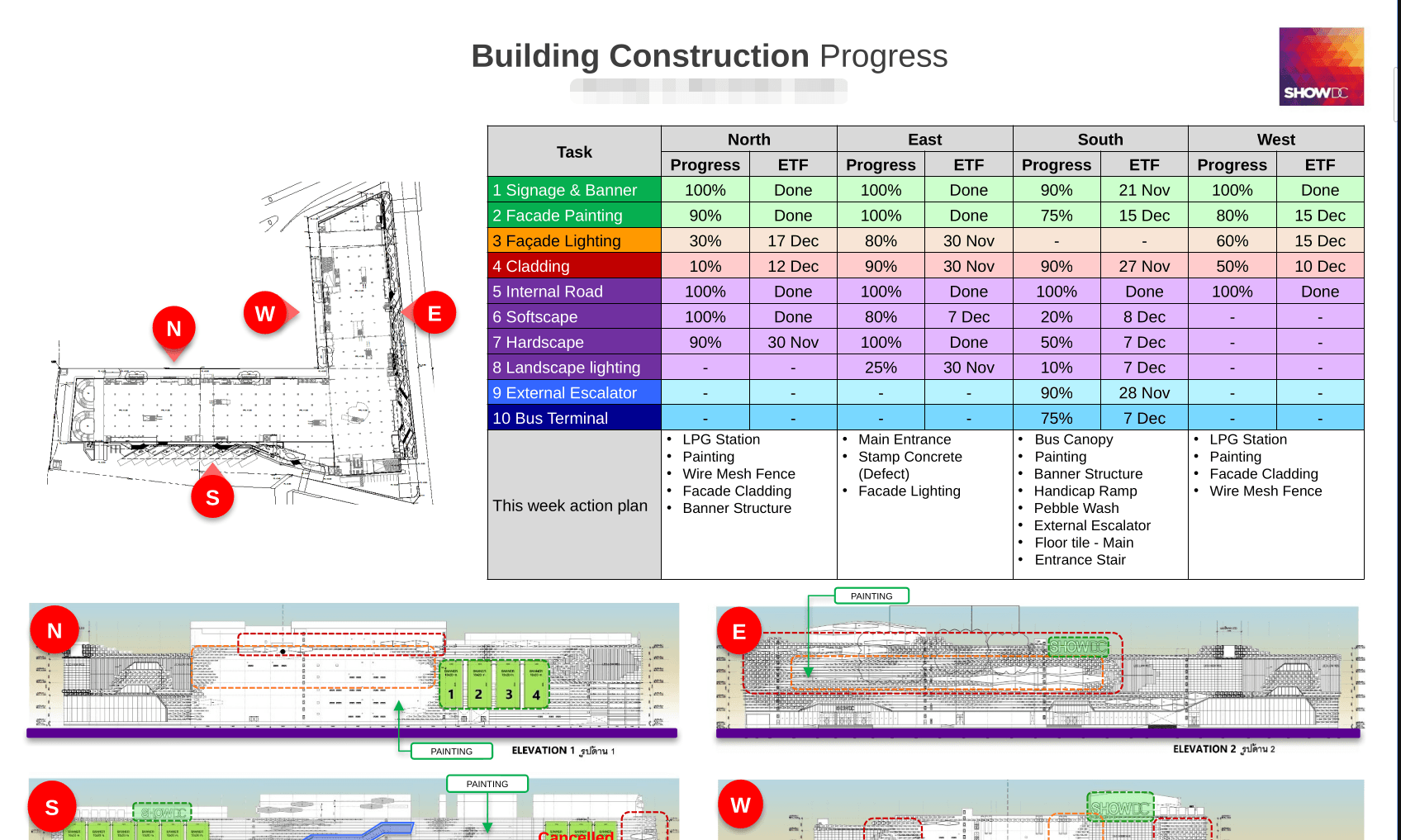
Façade & Construction Progress
Progress across north, east, south, and west façades with plan overlay.
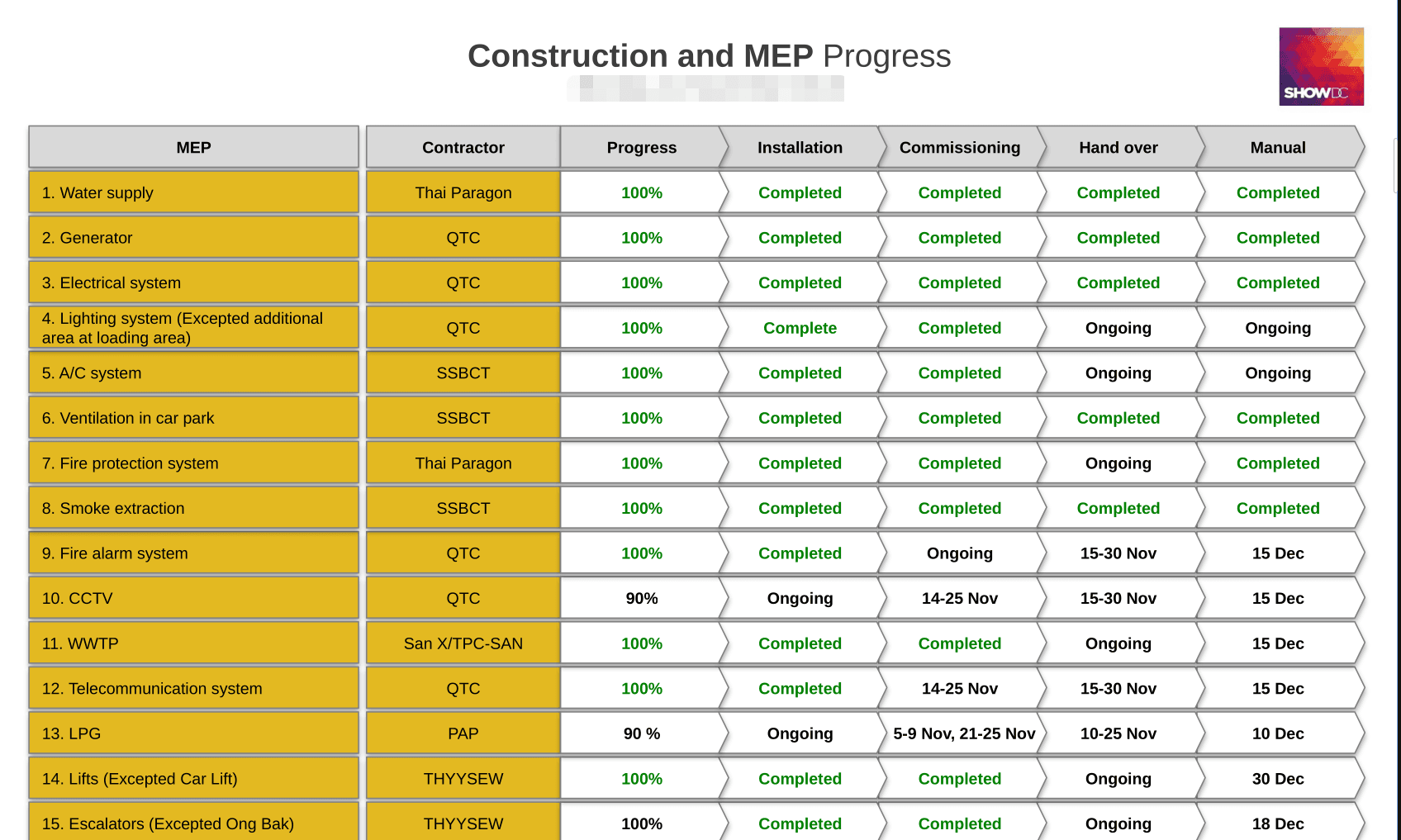
MEP System Completion Status
Progress table showing full installation, commissioning, and handover status for all major MEP systems.
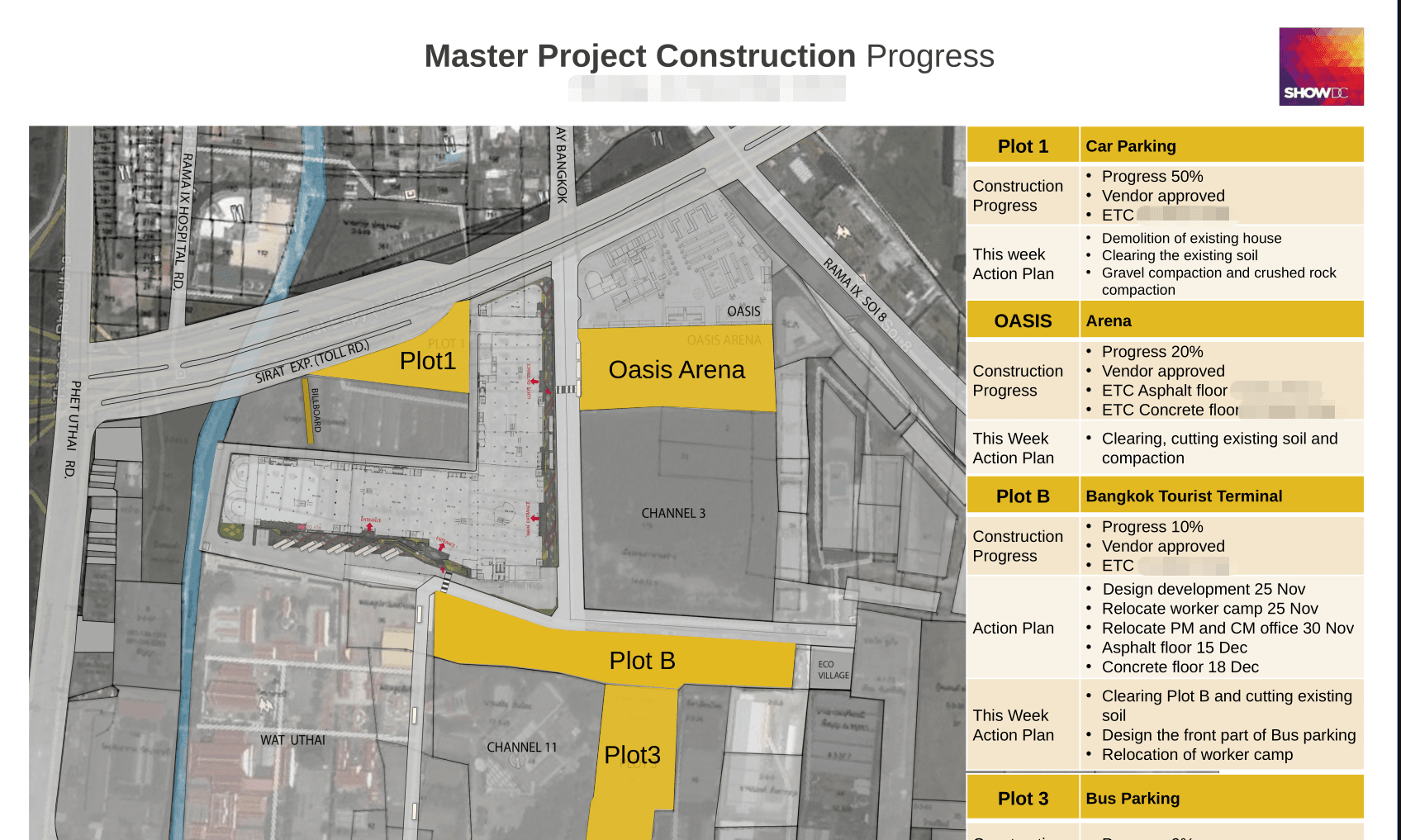
Master Site Construction Progress
A map of the overall development showing Plot 1, Oasis Arena, Plot B, and Plot 3 with progress summaries.
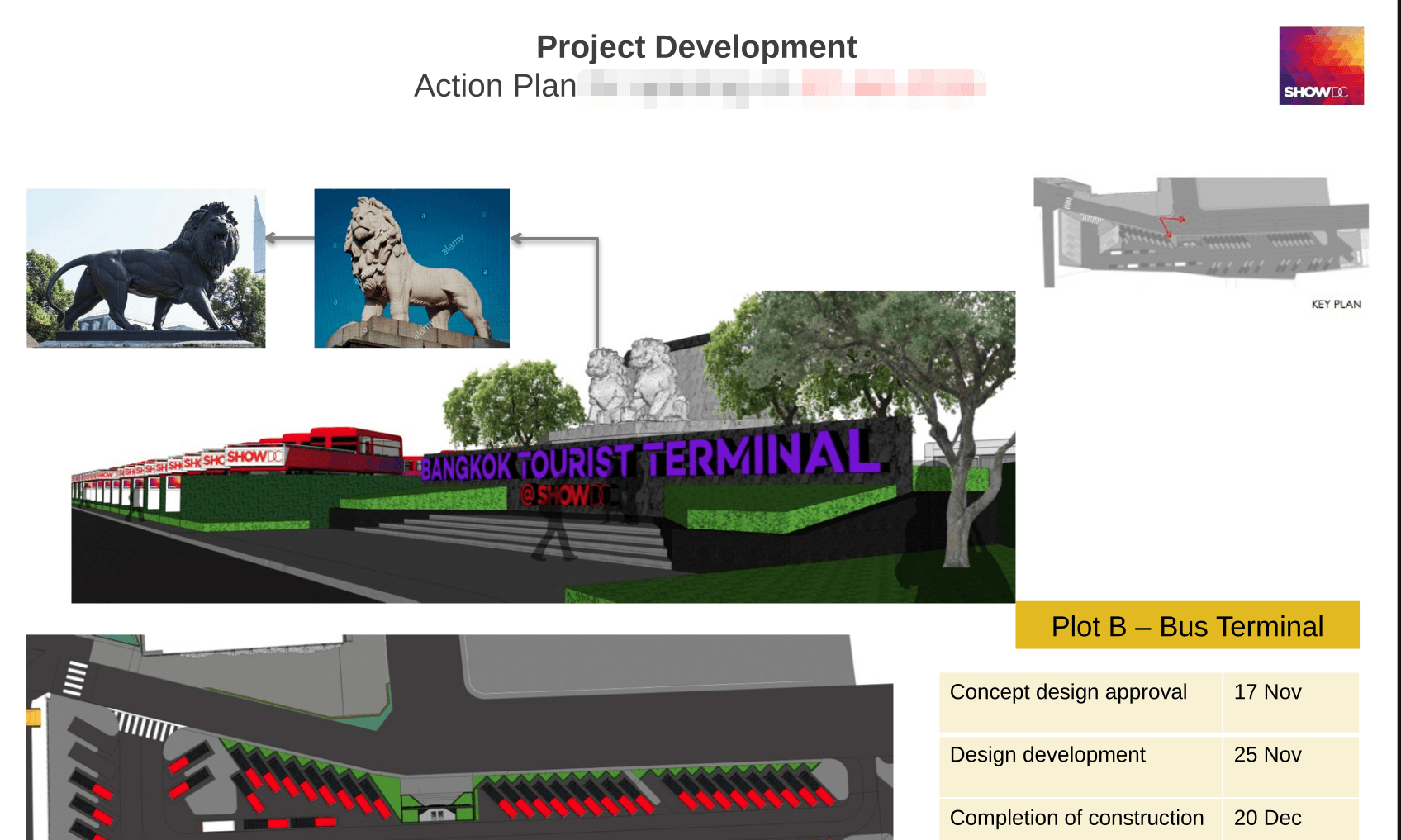
Bus Terminal Development
3D render and milestone dates for the Bangkok Tourist Terminal, a key sub-project within Show DC.
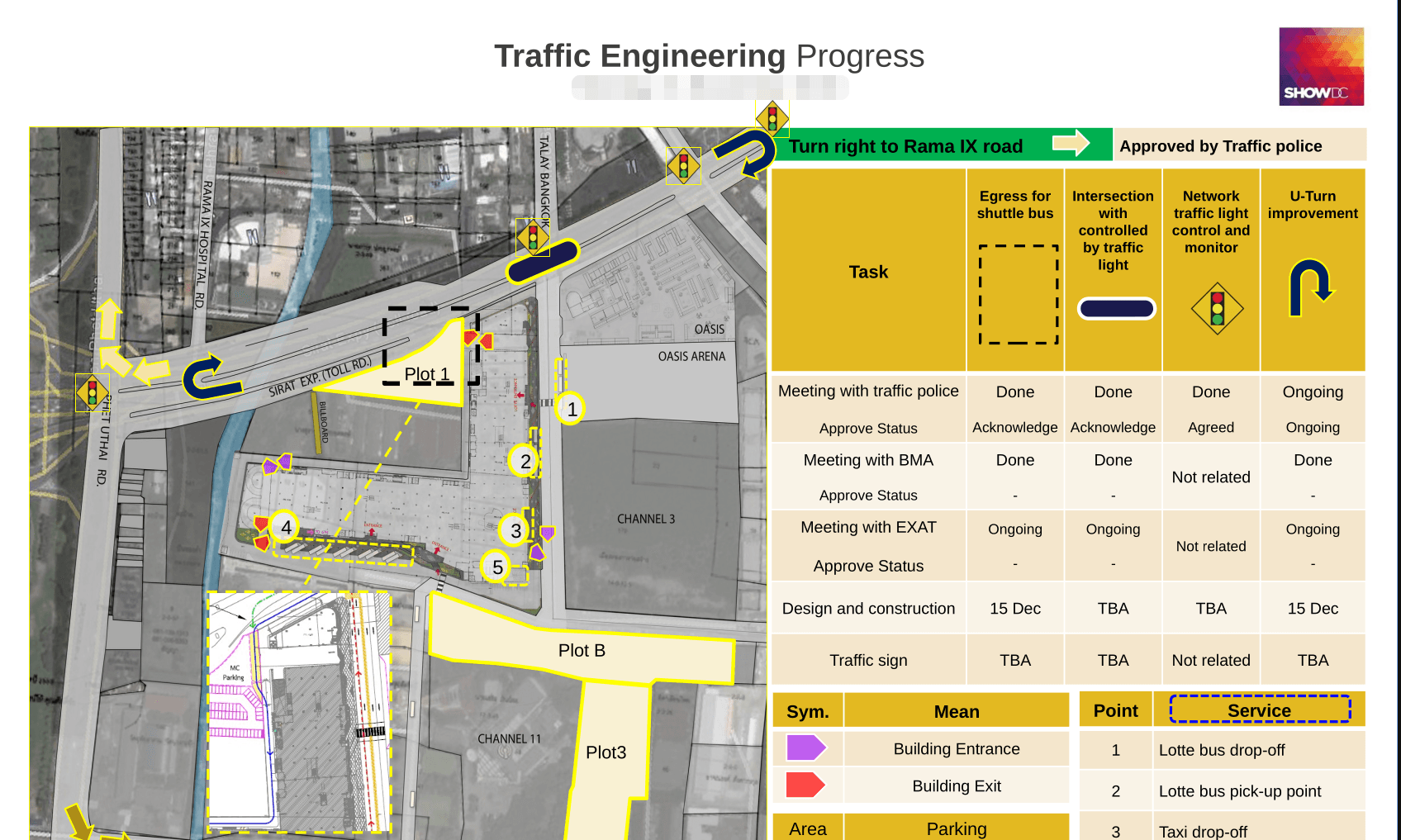
Traffic Engineering & Access Coordination
Traffic flow diagrams and authority approval status for access routes, signals, and U-turn improvements.
PM Workflow
How we structured and delivered the work from planning to handover.
Coordination, reporting, and execution were structured through defined routines covering design interfaces, tenant control, construction oversight, cost verification, authority management, and executive decision support.
Design & Interface Coordination
- Daily coordination across architects, engineers, consultants, and anchor tenants.
- Design decisions aligned with operational and commercial requirements.
- Downstream time and cost impacts identified before decisions issued.
Tenant Coordination & Fit-Out Control
- Submission and approval protocols formalized.
- Tenant handover, fit-out inspections, and mall-standard compliance managed.
- Unit readiness sequenced with construction and soft-opening plans.
Construction Oversight
- Civil, architectural, and MEP progress monitored across plots.
- Contractor reporting validated against programme requirements.
- Interface issues between packages and tenants resolved.
Budgeting & Cost Control
- Consolidated budgets maintained across all packages.
- Early warnings issued on design-driven cost impacts.
- Procurement, variations, and risk exposure tracked.
Authority & Access Coordination
- Utilities, traffic police, and relevant departments coordinated.
- Statutory approvals secured; operational readiness verified.
- External works managed: access, drainage, and public flow.
Executive Reporting
- Site activity translated into decision-ready reporting.
- Time, cost, design, and operations impacts highlighted.
- CEO and Executive Board briefed with structured recommendations.
Related Insights
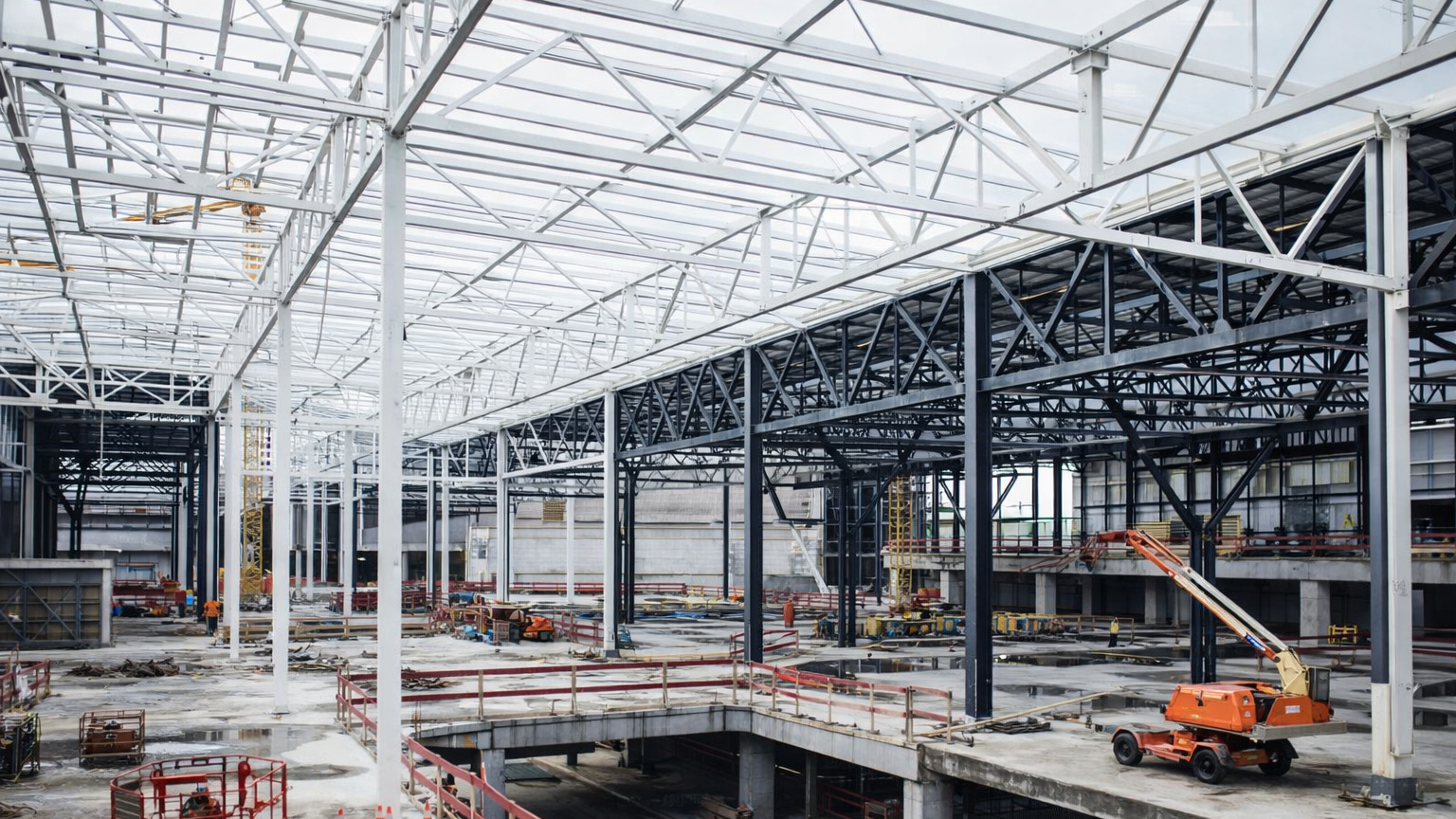
Optimism Without Coordination
January 7, 2026
Most construction problems don’t start as mistakes. They start as optimism—especially on fast-track projects where coordination is assumed rather than made explicit.
Read more →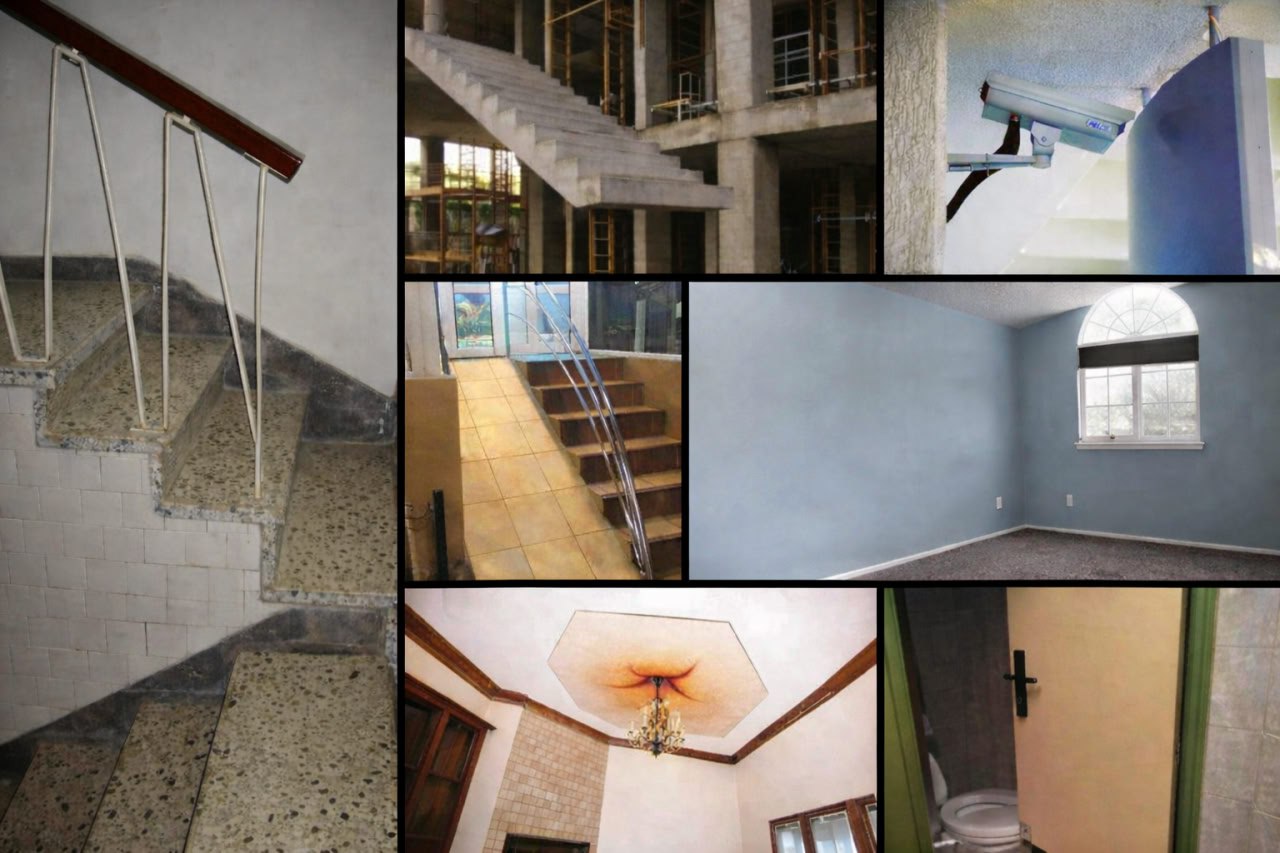
Construction Risk #4 – Design Risk
December 23, 2025
Design risk often sits quietly at the beginning of a project, but when unmanaged, it becomes one of the most expensive and disruptive risks during construction.
Read more →
Construction Risk #3 – Cost & Financial Risk
October 3, 2025
Cost overruns rarely happen all at once. They appear gradually — through uncoordinated drawings, delayed procurement, and slow reactions. Here’s how proactive cost management protects project vision.
Read more →Start with a project review
Share your project status or brief. We will identify where decision structure, coordination, or cost control need strengthening. We respond within one working day.